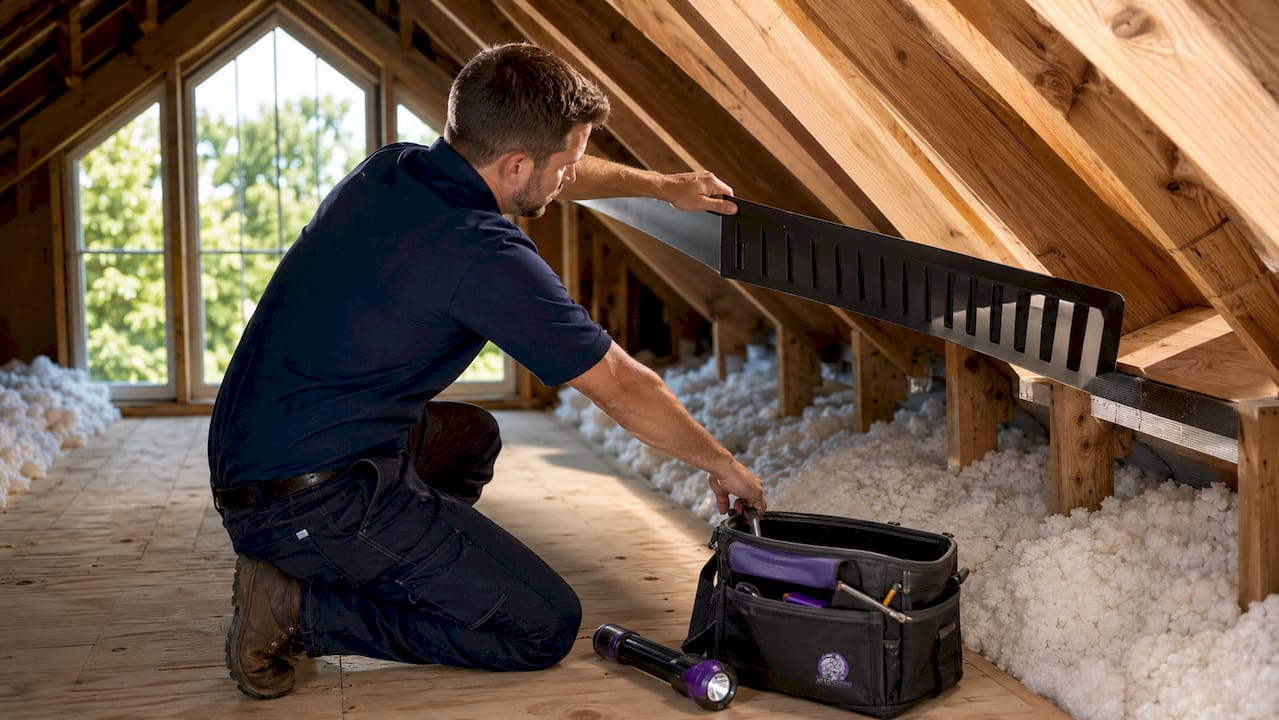
Attic baffles are rigid channels installed at the roof eaves that keep insulation from blocking soffit vents, maintaining uninterrupted airflow through your attic. The role of baffles in attic ventilation is foundational: without them, even a perfectly installed ridge vent and soffit vent system will stall. IRC Section R806.3 mandates a minimum 1-inch clear airway between insulation and the roof deck at the eaves. That requirement exists because blocked intake air is the single most common cause of attic ventilation failure. The Attic Genius sees this problem in homes across Chicagoland every week.
Why is installing baffles critical for proper attic ventilation?
Baffles are not optional accessories. They are the mechanism that keeps your intake vents open so convective airflow can actually move through the attic. Without them, insulation creeps toward the eaves and blocks soffit vents, cutting off the air supply that the entire ventilation system depends on.
When intake air is blocked, the consequences stack up fast:
- Moisture buildup: Warm, humid air from living spaces rises into the attic and has nowhere to go. Condensation forms on roof sheathing, leading to wood rot and structural damage.
- Mold growth: Trapped moisture creates ideal conditions for mold. Moisture accumulation can damage roof sheathing within a single winter season.
- Ice dams: In cold climates like Chicagoland, stalled ventilation allows heat to build unevenly along the roof deck, melting snow that refreezes at the eaves and forces water under shingles.
- Reduced insulation performance: Cold outside air can “wash” through insulation at the attic perimeter, reducing effective R-value and costing you money on heating and cooling.
- Ridge vent failure: Ridge vents only work when intake air flows in from the soffits. Missing or loose baffles cause the entire ventilation loop to stall, making the ridge vent useless.
The damage from poor attic ventilation is often hidden inside walls and under sheathing. By the time a homeowner notices a problem, the repair bill is significant. Understanding attic health hazards before they develop is far less expensive than fixing them after the fact.
Pro Tip: If your attic feels stuffy in summer or you notice frost on the underside of the roof deck in winter, blocked soffit vents from missing baffles are the most likely cause.
How to properly install baffles for maximum airflow
Correct installation determines whether baffles actually do their job. A baffle that is present but improperly secured is nearly as useless as no baffle at all. A baffle not properly stapled can shift under insulation pressure or wind, collapsing the air channel it was meant to protect.
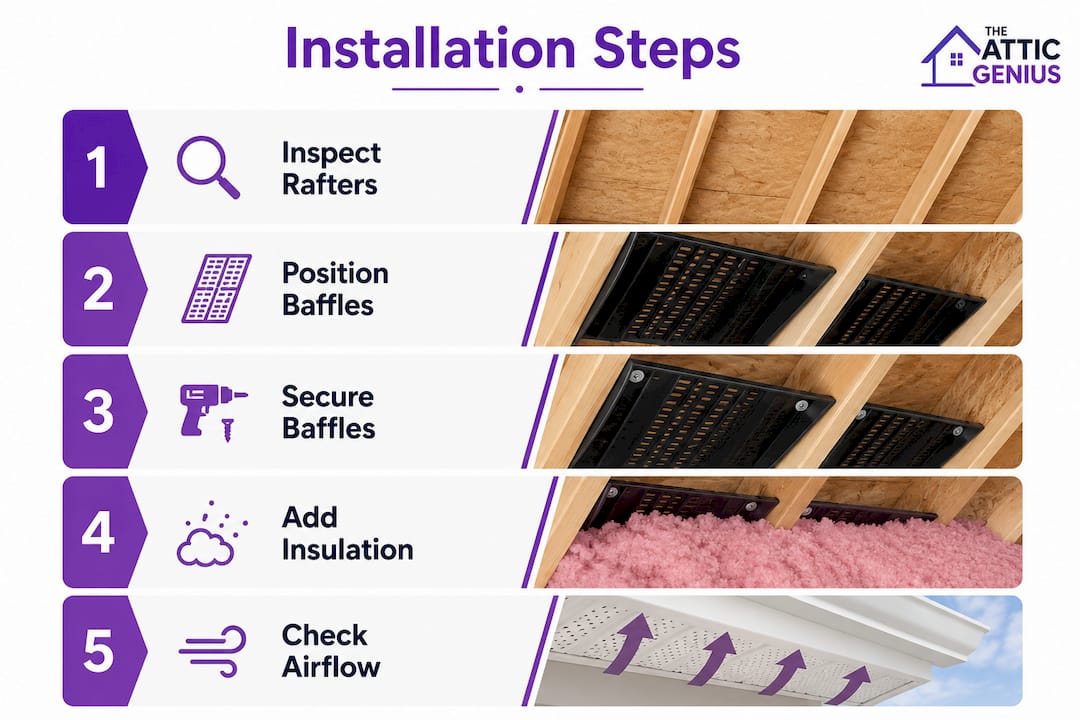
Follow these steps for installation that holds up:
- Install in every rafter bay with a soffit vent. Baffles belong in every rafter bay that aligns with a soffit vent opening. Skipping bays creates gaps in intake airflow.
- Start at the exterior wall plate. Position the bottom of each baffle at the top plate of the exterior wall. This ensures the air channel begins right where outside air enters.
- Extend at least 12 inches into the attic. The baffle needs to reach far enough past the wall plate that insulation cannot pile up and block the channel from behind.
- Staple securely to the rafters on both sides. Use enough staples to hold the baffle firmly against the rafter faces. A loose baffle will shift and fail.
- Maintain a minimum 1-inch air gap, ideally 2 inches. The gap between the top of the baffle and the roof deck is the actual airway. Two inches gives better airflow and leaves room for insulation settling.
- Replace damaged or buried baffles before adding insulation. Multiple insulation layers added over time commonly bury original baffles. Adding more insulation on top without installing taller baffles eliminates the air gap entirely.
Pro Tip: Before blowing in new insulation, walk the attic perimeter and physically check each rafter bay. If you cannot see a clear channel running from the soffit to the open attic space, a baffle is missing or buried.
Proper attic convection depends on this intake-to-ridge airflow path being unobstructed from end to end. Baffles are what make that path possible.
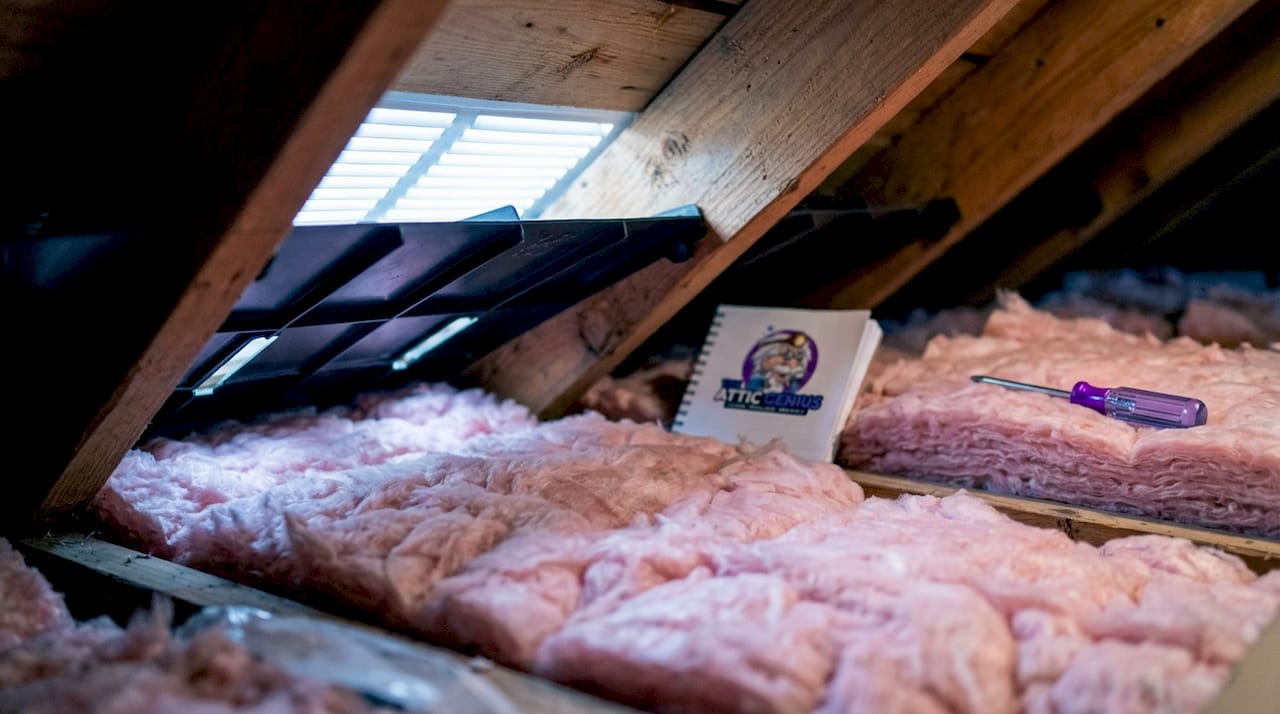
What is the relationship between baffles, insulation type, and ventilation systems?
Baffles work with most common insulation types, but the relationship is not identical across all materials. Understanding which insulation you have determines whether baffles are required, recommended, or irrelevant.
Blown-in insulation: baffles are non-negotiable
Blown-in cellulose and blown-in fiberglass are the most common insulation types in existing homes. Both materials are loose and will migrate toward the eaves over time, especially during installation when the blower pushes material outward. Baffles create a physical barrier that stops this migration and separates the insulation zone from the airflow path, preventing air washing and keeping insulation performing at its designed R-value.
Batts and rock wool: baffles still required
Fiberglass batts and rock wool batts are denser than blown-in materials but still compress against the roof deck at the eaves without baffles in place. Compressed insulation loses R-value and blocks airflow simultaneously. Baffles hold the batts away from the roof deck and maintain the required clearance.
Spray foam on the roof deck: no baffles needed
Unvented attic assemblies use closed-cell spray foam applied directly to the underside of the roof deck. This creates an air barrier rather than a ventilation channel. Installing baffles in unvented attics is a common mistake that traps moisture between the foam and the baffle. If your attic uses a hot roof assembly, baffles do not belong there.
| Insulation type | Ventilation strategy | Baffles required? |
|---|---|---|
| Blown-in cellulose | Vented attic with soffit and ridge vents | Yes |
| Blown-in fiberglass | Vented attic with soffit and ridge vents | Yes |
| Fiberglass or rock wool batts | Vented attic with soffit and ridge vents | Yes |
| Closed-cell spray foam on roof deck | Unvented (hot roof) assembly | No |
Homeowners adding insulation should also review common DIY insulation mistakes before starting. Choosing the wrong approach for your attic assembly is one of the most expensive errors you can make.
How to identify if your attic baffles are missing or damaged
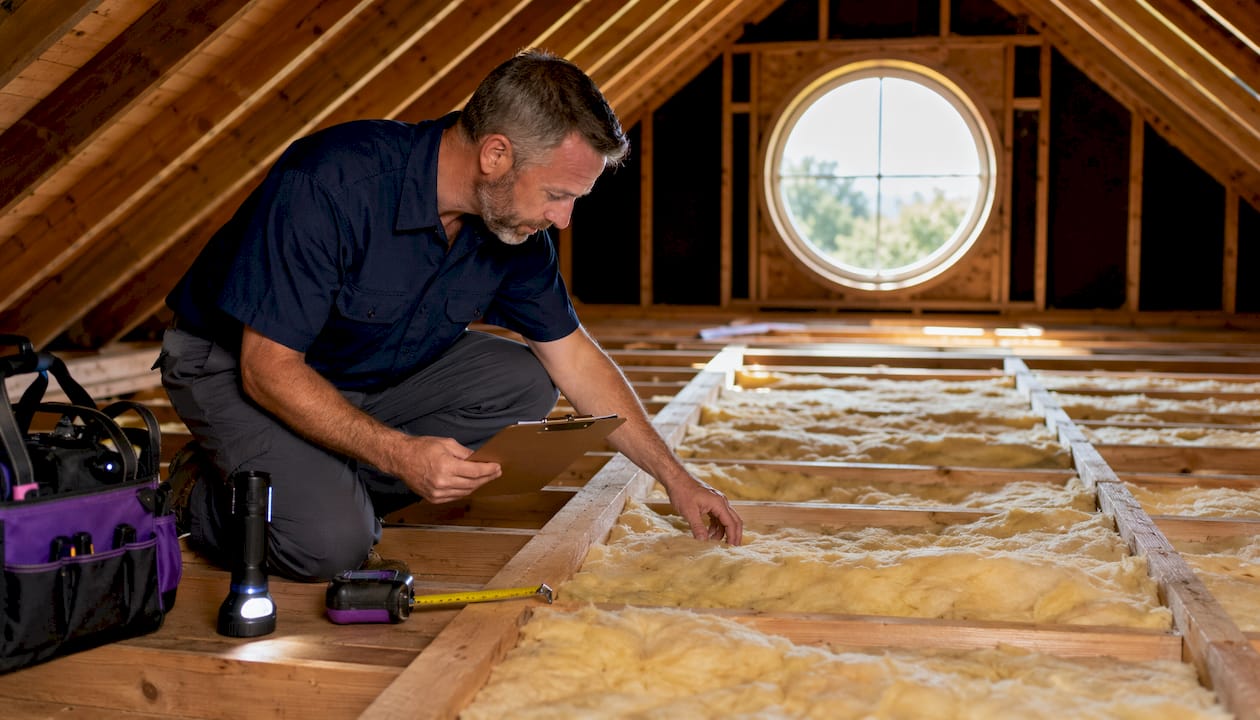
Most homeowners never inspect their baffles. The signs of failure show up as energy bills, moisture stains, and ice dams before anyone thinks to look at the eaves. A basic inspection takes less than 30 minutes and can prevent thousands of dollars in damage.
Look for these warning signs:
- Insulation packed to the roof deck at the eaves. If you cannot see any gap between the insulation and the roof sheathing near the soffit, the air channel is blocked.
- No visible air channels in rafter bays. Each rafter bay should show a clear slot running from the soffit toward the attic center. If the bay is solid insulation, baffles are missing or buried.
- Crushed or bent baffles. Damaged baffles reduce ventilation quality and must be replaced. Older baffles from previous insulation jobs are often compromised by weight or age.
- No airflow at soffit vents. Hold your hand near a soffit vent on a windy day. You should feel air moving. No airflow means the intake is blocked, even if the vent itself is open.
- Frost or condensation on roof sheathing in winter. This is a direct sign that warm, humid air is not being exhausted. Blocked intake from missing baffles is the most common cause.
Loose or improperly fastened baffles fail to hold air channels open despite appearing to be in place. Inspections regularly find baffles that have shifted under insulation pressure and no longer serve any function.
Pro Tip: Bring a flashlight and look along the eave line from inside the attic. A properly installed baffle creates a visible slot of light or open space between the insulation and the roof deck. If you see solid insulation all the way to the roof, call a professional.
Key Takeaways
Attic baffles are the foundation of a working ventilation system. Without them, soffit vents cannot deliver intake air, insulation loses R-value, and moisture damage follows.
| Point | Details |
|---|---|
| Baffles are code-required | IRC Section R806.3 mandates a minimum 1-inch air gap between insulation and roof deck at eaves. |
| Missing baffles cause real damage | Blocked intake leads to moisture buildup, mold, ice dams, and reduced insulation performance. |
| Installation must be thorough | Install in every rafter bay, staple firmly, and maintain a 1–2 inch air gap from the roof deck. |
| Insulation type determines baffle need | Vented attics with blown-in or batt insulation require baffles; unvented spray foam assemblies do not. |
| Inspection catches problems early | Look for insulation packed to the roof deck, no visible air channels, or frost on sheathing. |
Why I never skip baffles, even on simple insulation jobs
I have been in hundreds of attics across Chicagoland, and the pattern is always the same. A homeowner adds insulation to cut energy costs, the contractor skips the baffles to save time, and two winters later the homeowner is dealing with mold on the sheathing or ice dams tearing up the gutters. The insulation job that was supposed to save money ends up costing three times as much to fix.
Baffles are treated as optional by too many contractors. They are not. A vented attic without baffles is like a furnace with a blocked flue. The system exists, but it cannot function. Every blown-in insulation job I oversee starts with a baffle check. If they are missing, buried, or damaged, we install new ones before a single pound of insulation goes in.
The other mistake I see constantly is homeowners combining good insulation with zero air sealing. Baffles protect the ventilation channel, but air sealing stops conditioned air from leaking into the attic in the first place. You need both. One without the other leaves money on the table and moisture in the wood.
Baffles are not glamorous. They are not the part of an attic upgrade that anyone gets excited about. But they are the part that determines whether everything else works. Skip them and you are building on a broken foundation.
— Jim
The Attic Genius can assess and fix your attic ventilation
If you are not sure whether your baffles are in place, intact, or doing their job, a professional assessment removes the guesswork.

The Attic Genius serves homeowners across Chicagoland and the Northwest Suburbs with same-day attic inspections, professional ventilation services, and full insulation upgrades. Our team checks baffle condition as part of every assessment, and we install new baffles before adding any insulation. We also handle air sealing services to complete the system. If you are seeing signs of moisture damage or high energy bills, check out our guide on attic insulation upgrade signs to know what to look for before you call.
FAQ
What are attic baffles and what do they do?
Attic baffles are rigid channels installed in each rafter bay at the roof eaves. They hold insulation away from the soffit vents, keeping a clear airway between the insulation and the roof deck so ventilation can flow from intake to ridge.
Are attic baffles required by building code?
Yes. IRC Section R806.3 requires a minimum 1-inch clear airway between insulation and the roof deck at the eaves. Missing baffles in a vented attic assembly are a code violation.
Can I add insulation without installing baffles first?
Adding insulation without baffles in a vented attic blocks soffit intake and stalls the entire ventilation system. Always install or verify baffles before adding any blown-in or batt insulation.
Do all attics need baffles?
Vented attics with soffit and ridge vents require baffles in every rafter bay. Unvented attic assemblies using closed-cell spray foam applied directly to the roof deck do not use baffles and should not have them installed.
How do I know if my baffles are working?
Check from inside the attic with a flashlight. Each rafter bay near the eaves should show a visible air channel between the insulation and the roof deck. No visible gap, crushed baffles, or insulation packed to the sheathing all indicate the baffles are missing or failing.