Mineral wool insulation is an inorganic, fiber-based material made by spinning molten rock or industrial slag into fine fibers — and homeowners choose it for three reasons that few other insulation types can match simultaneously: thermal resistance, non-combustibility, and sound control. Specific products from manufacturers like ROCKWOOL and Knauf typically deliver:
- Thermal resistance of roughly R-3.7 to R-4.3 per inch, depending on product density
- Non-combustibility, with stone wool products capable of withstanding temperatures that would melt or ignite most competing materials
- Acoustic performance that outpaces standard fiberglass in party walls, floor-ceiling assemblies, and attic spaces
If you’re weighing insulation options for an attic, a retrofit wall, or a fire-rated assembly, mineral wool belongs near the top of your list.
Key Takeaways
Mineral wool insulation combines non-combustibility, thermal resistance of roughly R-3.7 to R-4.3 per inch, and high-density acoustic performance in a single inorganic material that can last 30 to 75+ years when installed correctly and kept dry.
| Point | Details |
|---|---|
| Definition and composition | Mineral wool is made from spun molten rock, slag, or glass; rock and slag wool are the most common residential types. |
| R-value range | Specific products deliver roughly R-3.7 to R-4.3 per inch — always verify against the manufacturer’s datasheet for the exact product. |
| Fire and acoustic advantage | Stone wool is non-combustible and outperforms fiberglass on sound blocking due to higher density. |
| Safety during installation | Wear long sleeves, gloves, eye protection, and an N95 respirator; mineral wool causes mechanical irritation but is not classified as a known carcinogen. |
| The Attic Genius | The Attic Genius provides attic insulation, air sealing, and inspection services across Chicagoland — with upfront pricing and same-day inspections available. |
Table of Contents
- What is mineral wool insulation made of?
- How is mineral wool manufactured?
- What performance can you expect from mineral wool?
- What forms does mineral wool come in, and where is each used?
- How is mineral wool installed, and what precautions matter?
- Is mineral wool safe? Health and regulatory notes
- How does mineral wool compare to other common insulation materials?
- How sustainable and long-lasting is mineral wool?
- What drives the cost of a mineral wool installation?
- How to choose the right mineral wool product and installer
- Why mineral wool earns its place in attic work
- Attic insulation services from The Attic Genius in Chicagoland
- Sources
What is mineral wool insulation made of?
Mineral wool is a broad category covering three distinct product families, each built from different raw materials and suited to different jobs.
Rock wool (stone wool) starts with volcanic basalt or diabase rock. The raw stone is melted at extremely high temperatures, then spun into fibers. The resulting product is dense, dimensionally stable, and has a higher melting point than glass-based alternatives. ROCKWOOL is the most recognized brand in this category, and their products are commonly specified for fire-rated wall assemblies and commercial curtain walls.
Slag wool uses blast-furnace slag, a byproduct of iron and steel production, as its primary feedstock. The manufacturing chemistry is similar to rock wool, but slag’s lower melting point makes it slightly less suited to the highest-temperature applications. It’s widely used in residential blown-in attic insulation across the U.S. Knauf produces slag-based products alongside glass wool options.
Glass wool (also called fiberglass or synthetic vitreous fiber) uses silica sand and recycled glass cullet. It’s lighter and less dense than rock or slag wool, which affects both its acoustic performance and its fire behavior. Stone wool products are typically non-combustible and can withstand higher temperatures than glass wool, which is why glass wool rarely appears in fire-rated assemblies that demand the highest performance.
| Type | Primary Raw Material | Relative Density | Best Typical Uses |
|---|---|---|---|
| Rock/stone wool | Basalt, diabase | High | Fire-rated assemblies, party walls, acoustic partitions |
| Slag wool | Blast-furnace slag | Medium-high | Attic blown-in, residential batts |
| Glass wool | Silica sand, glass cullet | Low-medium | General building insulation, HVAC duct wrap |
A practical note: when a contractor or product spec sheet says “mineral wool,” they almost always mean rock or slag wool. Glass wool is more commonly sold under the fiberglass label in residential contexts, though technically it falls under the same synthetic vitreous fiber umbrella.
How is mineral wool manufactured?
The manufacturing process follows a consistent sequence regardless of whether the feedstock is rock, slag, or glass:
- Melting — Raw materials are fed into a furnace and melted at temperatures typically exceeding 1,500°C (2,732°F).
- Fiberization — The molten material is poured onto spinning wheels or drawn through small orifices. Centrifugal force throws the melt into fine, hair-like fibers. Blown mineral wool is produced by melting rock or blast-furnace slag and fiberizing the melt by centrifugal spinning.
- Binder or de-dusting agent application — For bonded products (batts, boards), a binder — commonly a phenol-formaldehyde resin — is sprayed onto the fiber mat. Loose-fill products are generally unbonded or receive only a light de-dusting agent to reduce airborne fiber during installation.
- Curing — The fiber mat passes through a curing oven that sets the binder and locks the product’s density and thickness.
- Cutting and packaging — Cured product is cut to standard dimensions (batts, boards) or shredded into loose-fill form, then packaged.
The distinction between unbonded loose-fill and bonded batts matters practically. Loose-fill generates more airborne fiber during installation because there’s no binder holding fibers together. Bonded batts and boards are more dimensionally stable and produce less dust when cut cleanly. Hydrophobic treatments, applied during or after fiberization, cause water to bead off the product rather than absorb — a feature worth verifying on the product datasheet before specifying mineral wool in a moisture-prone location.
Recycled content enters the process primarily through slag (a steel-industry byproduct) and, for glass wool, post-consumer glass cullet. This is one reason mineral wool products often carry meaningful recycled-content percentages in their environmental product declarations.
Pro Tip: When comparing installer quotes, ask specifically whether the product is bonded or unbonded and whether it carries a hydrophobic treatment. Unbonded loose-fill in an attic with any moisture risk is a different product decision than a bonded batt in a wall cavity, and not every installer volunteers that distinction.
What performance can you expect from mineral wool?
Thermal resistance
Mineral wool’s R-value per inch sits in a range that competes well with fiberglass and outperforms it slightly at higher densities. Thermafiber® products, for example, list R-values of roughly 3.7–4.3 per inch depending on product and density. That range is product-specific — always verify against the manufacturer’s datasheet for the exact product you’re buying, not a generic category figure.
Density also affects settling. Higher-density mineral wool batts hold their R-value over time without the compression-related performance loss that can affect lower-density materials. In an attic where blown-in insulation is subject to foot traffic or storage, that stability matters.
Mineral wool products like Thermafiber® list an R-value range approximately between 3.7 and 4.3 per inch, depending on product density; exact values should be confirmed on the manufacturer’s datasheet.
Fire resistance
This is where mineral wool genuinely separates itself. Stone wool is inorganic and non-combustible, meaning it doesn’t contribute fuel to a fire. It’s used in fire-rated wall assemblies, curtain wall perimeter fire containment, and firestopping applications precisely because it maintains structural integrity at temperatures that would cause fiberglass to melt and foam products to burn. Building codes in the U.S. reference ASTM fire test standards for these assemblies, and product datasheets list the specific tested configurations.
Acoustic performance
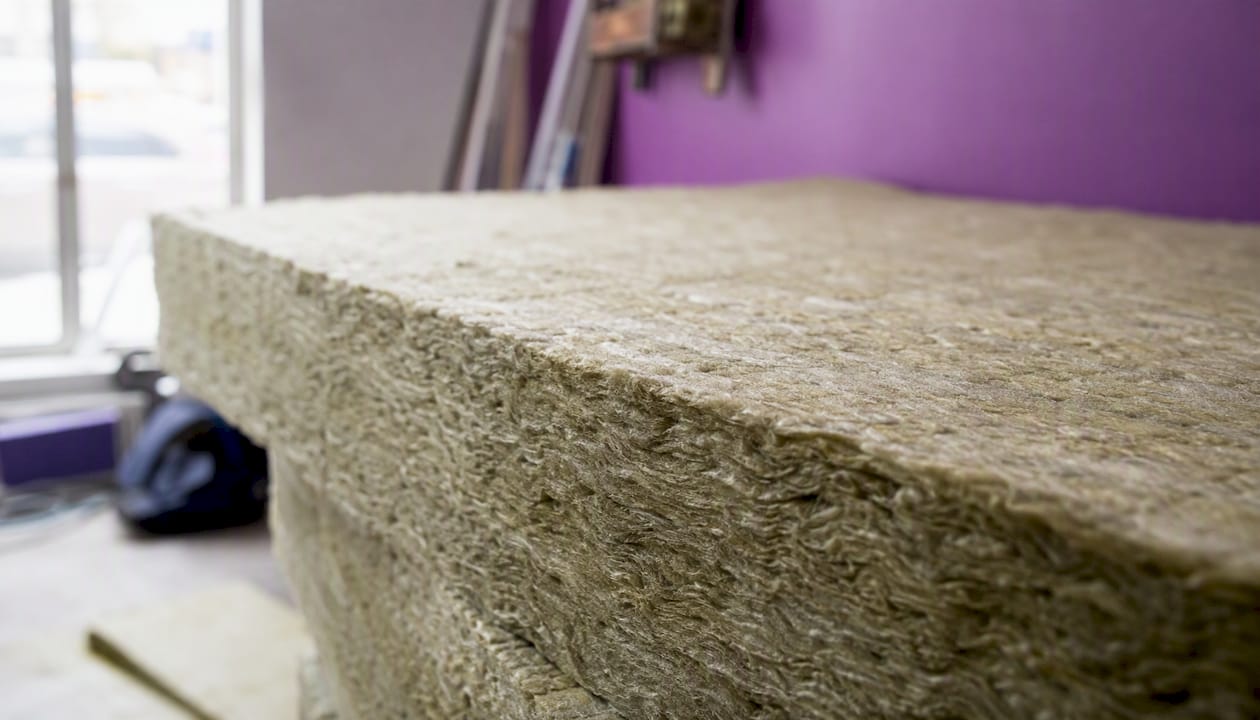
Mineral wool’s higher density is the key variable here. Denser mineral wool batts produce noticeably better sound-blocking than standard fiberglass — a difference that shows up clearly in party walls and floor-ceiling assemblies. If you’re insulating a home theater, a bedroom wall adjacent to a garage, or a multi-family unit, the density difference is worth paying for.
Moisture and mold resistance
Mineral wool is inorganic, so it doesn’t feed mold growth the way cellulose or wood-based materials can. Products with hydrophobic treatment repel liquid water effectively. That said, untreated mineral wool can absorb moisture if it’s in sustained contact with water — and saturated insulation loses R-value and can eventually degrade. Keeping the material dry during installation and ensuring proper attic ventilation afterward is non-negotiable.
Pro Tip: Check the product datasheet for a water repellency specification before using mineral wool in a below-grade application or any location where bulk water contact is possible. Not all mineral wool products carry the same hydrophobic treatment.
What forms does mineral wool come in, and where is each used?
Product forms
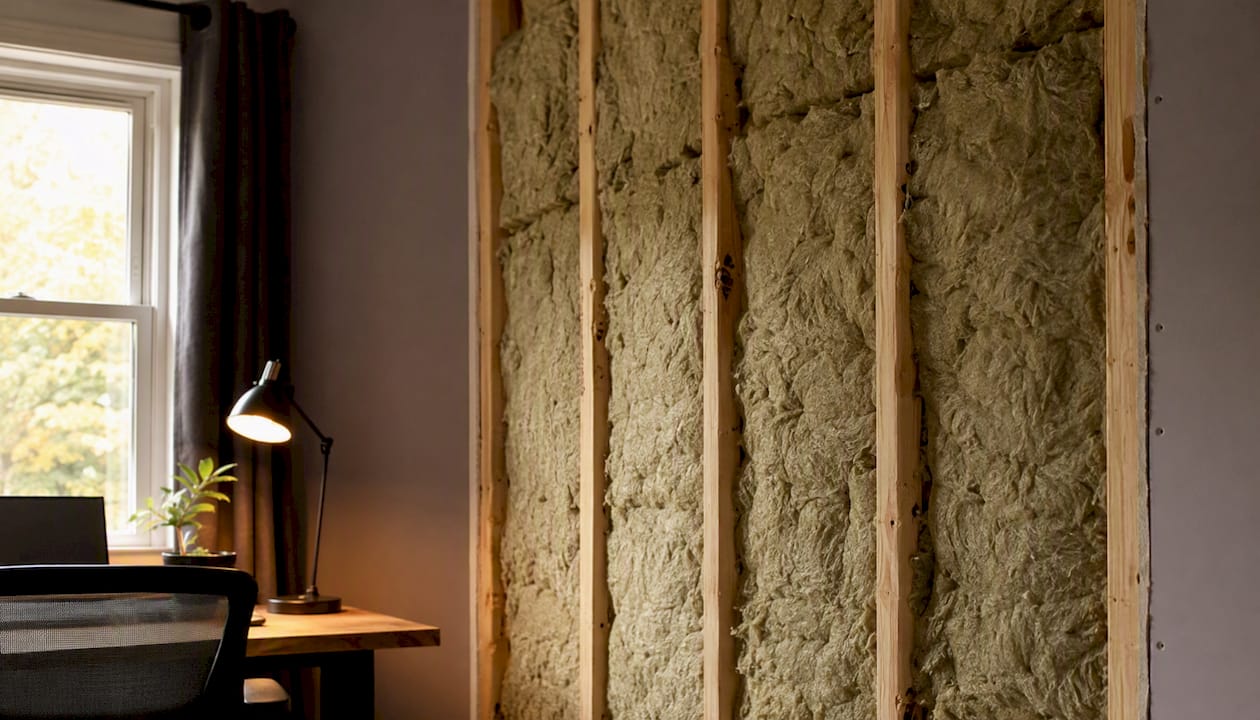
- Batts and rolls — The most common residential form. Friction-fit into wall cavities, floor joists, and attic rafters. Available faced (with kraft paper or foil vapor retarder) or unfaced. Sized to standard 16" and 24" stud spacing.
- Loose-fill (blown-in) — Shredded mineral wool blown into attic floors, wall cavities (dense-pack), or irregular spaces using a blowing machine. Excellent for retrofit attic work where access is limited. See blown-in insulation advantages for a fuller picture of why this form suits attic retrofits.
- Rigid boards — High-density mineral wool boards used for continuous insulation on exterior walls, under roofing membranes, and in commercial assemblies. Dimensionally stable and compatible with cladding attachment.
- Pipe and duct wraps — Flexible or semi-rigid mineral wool products designed to wrap HVAC ductwork, pipes, and mechanical equipment. Provide both thermal and fire protection.
Typical applications by location
- Attics — Blown-in or batt installation on the attic floor is the most common residential use. Mineral wool’s fire resistance and mold resistance make it a strong choice, particularly in older homes where air sealing is incomplete.
- Walls — Batts in wood-frame cavities; rigid boards for continuous exterior insulation; dense-pack blown-in for retrofit cavity walls.
- Floors over unconditioned spaces — Batts friction-fit between floor joists, or rigid boards under a subfloor.
- Mechanical rooms and HVAC — Pipe wraps and duct insulation where fire rating and temperature tolerance matter.
- Fire-rated assemblies and firestopping — Curtain wall perimeter containment, shaft liner applications, and through-penetration firestopping in commercial construction.
For retrofit attic work, blown-in mineral wool or high-density batts are typically the better fit than rigid boards. New construction gives you more flexibility to specify boards for continuous insulation layers. If you’re also dealing with moisture concerns in a basement or crawl space, basement and crawl space insulation involves different product selection criteria than attic work.
How is mineral wool installed, and what precautions matter?
Typical installation sequence
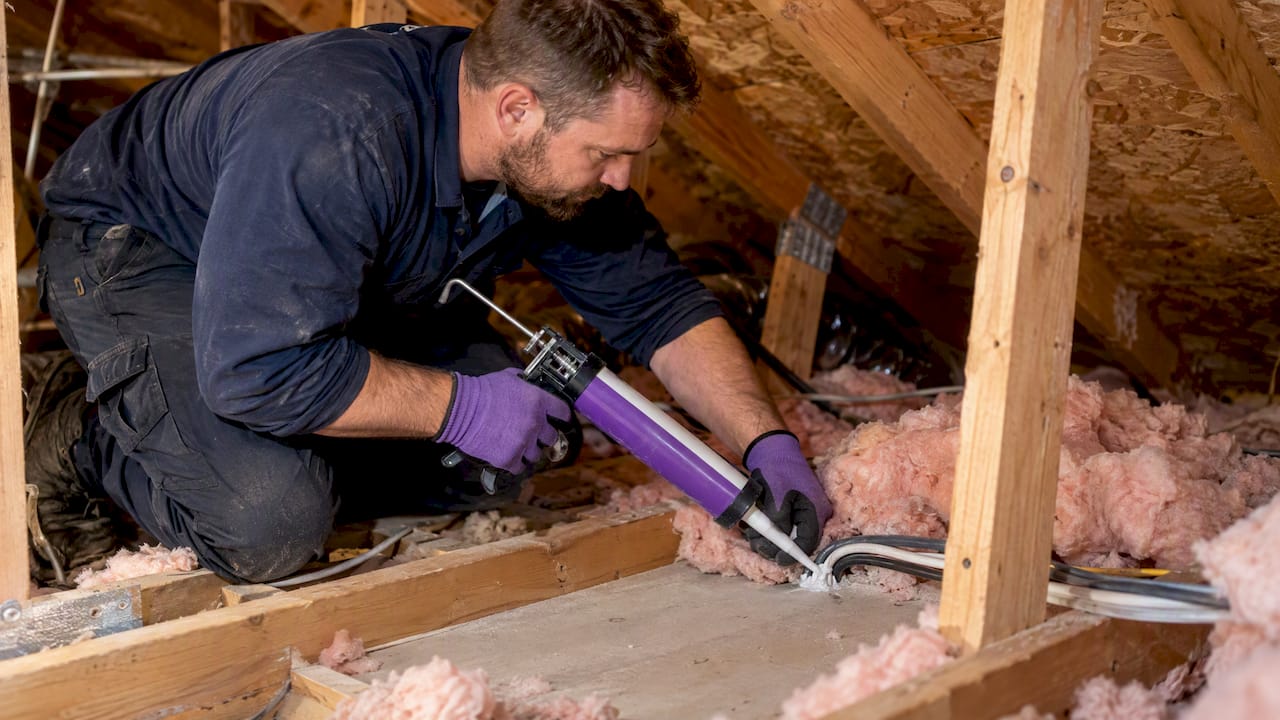
- Prep and air sealing — Before any insulation goes in, gaps, penetrations, and bypasses should be sealed. Air sealing is not optional; insulation placed over unsealed bypasses loses a significant portion of its thermal benefit. Review how to prepare your attic for an insulation upgrade before a contractor arrives.
- Baffle installation (attic) — In vented attics, baffles protect the ventilation channel at the eaves before blown-in or batt insulation is added.
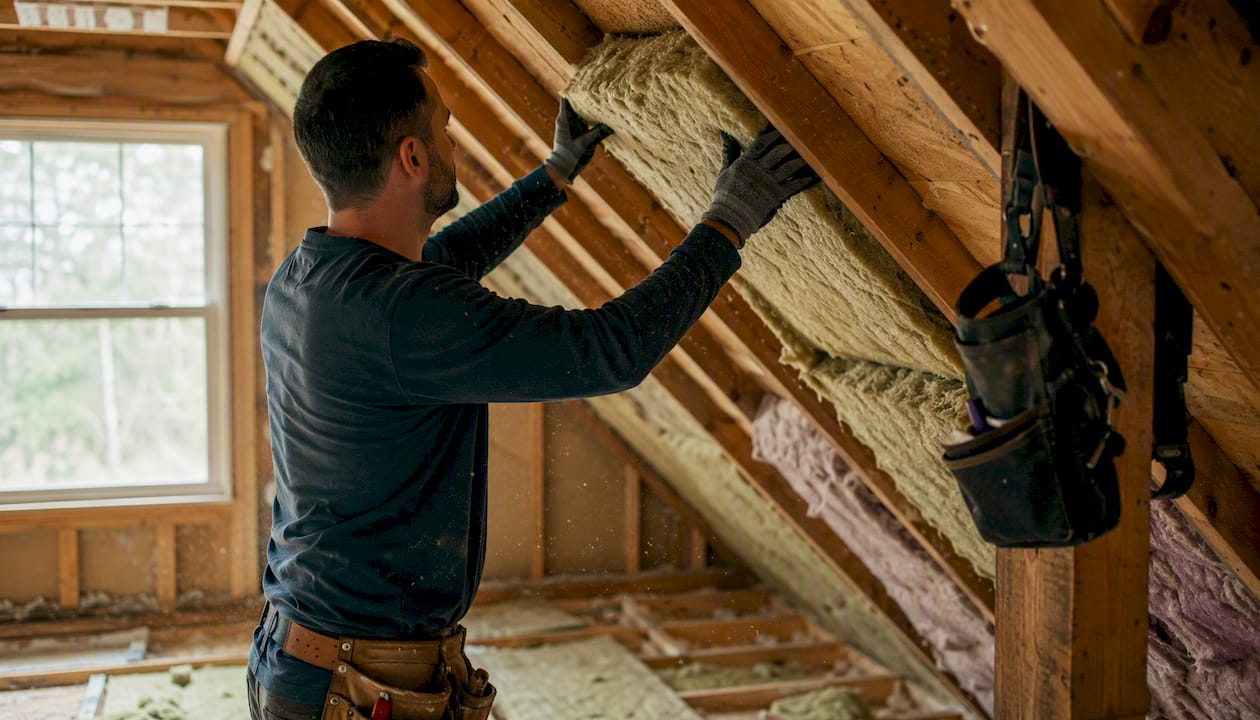
- Material installation — Batts are friction-fit without compression; blown-in is distributed to the target depth; boards are mechanically fastened or adhered per the manufacturer’s specification.
- Depth and coverage inspection — Blown-in installations should be checked with depth markers. Batt installations should be inspected for gaps, voids, and any compression around framing.
Compression kills R-value. A batt compressed to half its designed thickness loses a substantial portion of its rated thermal performance. Never stuff mineral wool into a space smaller than its designed thickness.
Essential precautions
Mineral wool fibers cause mechanical irritation to skin, eyes, and the respiratory tract during cutting and installation. NIOSH and CDC guidance recommends full PPE for anyone handling mineral wool:
- Long sleeves and gloves to prevent skin contact
- Safety glasses or goggles
- An N95 respirator at minimum when cutting or blowing
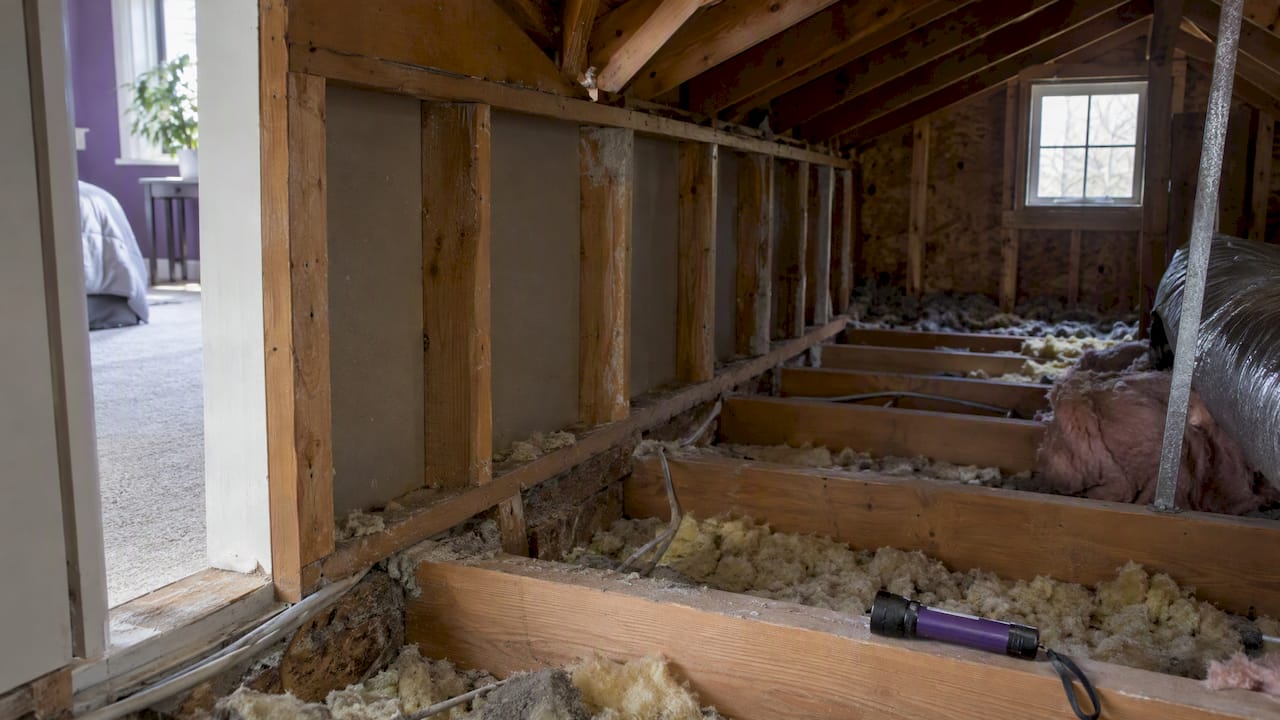
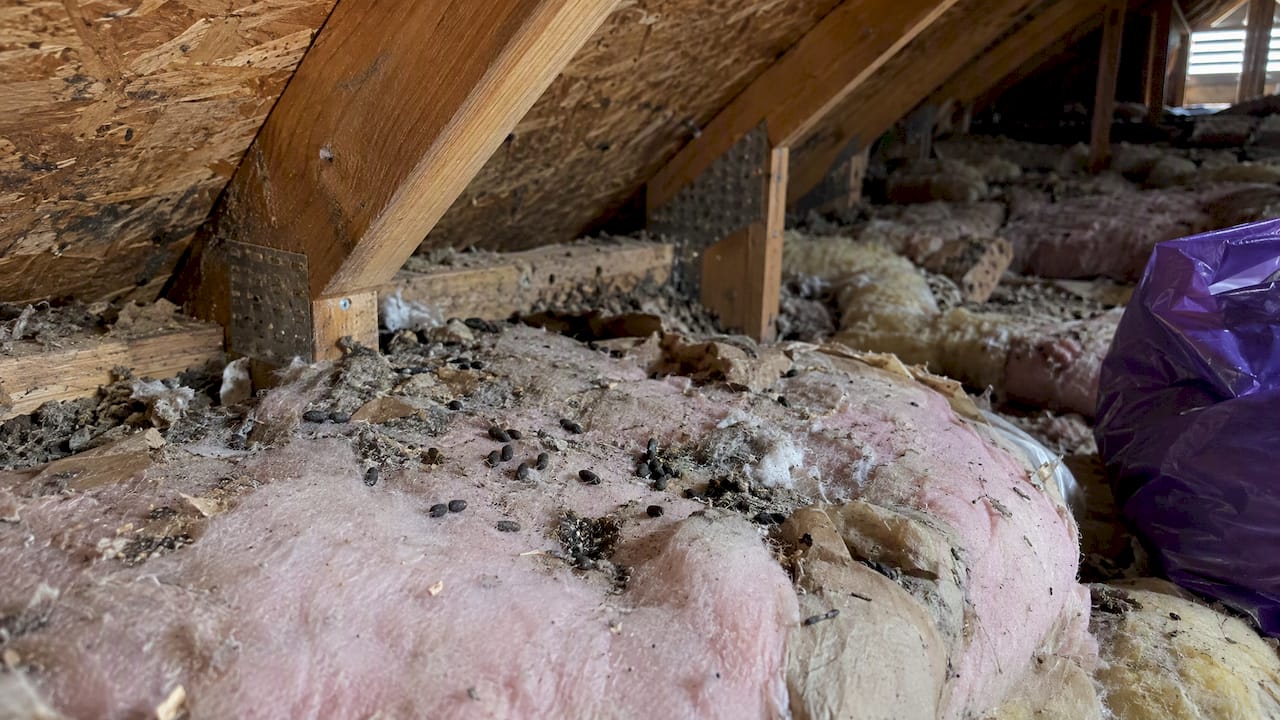
Keep the material dry before and during installation. Wet mineral wool loses R-value and is harder to install correctly. If you’re doing a retrofit attic job and discover existing moisture damage or pest waste, that’s a removal-and-remediation job before new insulation goes in — not a layer-over situation. Common attic insulation mistakes often involve skipping this step.
For most homeowners, a professional installer is the right call for blown-in work and any job involving removal of old insulation, mold, or pest contamination.
Is mineral wool safe? Health and regulatory notes
The short answer: mineral wool is not classified as a known human carcinogen by major regulatory bodies, but it does cause mechanical irritation during handling, and proper PPE is required.
EPA technical summaries describe synthetic vitreous fibers — including glass wool, rock wool, and slag wool — and note that acute upper-respiratory irritation can occur from inhalation exposures. The EPA and IARC have placed many modern mineral wools in a category described as “not classifiable as to carcinogenicity to humans,” reflecting the current weight of evidence. That classification is not a green light to handle the material without protection; it’s a statement about long-term cancer risk at typical exposure levels, not about the very real short-term irritation the fibers cause.
PPE checklist for handling mineral wool
- Long-sleeved shirt and long pants (fibers irritate exposed skin on contact)
- Chemical-resistant or work gloves
- Safety glasses or goggles (not just safety glasses with open sides)
- N95 respirator minimum; a half-face respirator with P100 filters for sustained cutting or blowing work
Reducing household exposure during retrofit
Close off the work area from living spaces. Run the work with windows open or exhaust ventilation active. Bag and seal cut scraps immediately rather than leaving them loose. After installation, HVAC filters should be checked and replaced if the system ran during the work.
Regulatory note: IARC and EPA classifications for mineral wool fibers apply to modern, biosoluble formulations. Older installations may contain different fiber chemistries — consult a professional if you’re removing insulation of unknown age or origin.
Disposal
Mineral wool is generally accepted at construction and demolition (C&D) waste facilities. Some manufacturers, including ROCKWOOL, have published guidance on recycling mineral wool production waste back into the manufacturing process, though post-installation recycling programs for homeowners vary by region. Check with your local waste authority before disposal.
How does mineral wool compare to other common insulation materials?
| Property | Mineral wool | Fiberglass | Cellulose | Open-cell spray foam | Closed-cell foam board |
|---|---|---|---|---|---|
| R-value per inch | ~3.7–4.3 | ~2.2–3.8 | ~3.2–3.8 | ~3.5–3.6 | ~6.0–6.5 |
| Fire resistance | Non-combustible | Melts, non-combustible | Combustible (treated) | Combustible | Combustible |
| Acoustic performance | High (dense) | Low-medium | Medium | Low-medium | Low |
| Moisture/mold resistance | High (inorganic, hydrophobic) | Medium | Low (absorbs moisture) | High | High |
| Common forms | Batts, blown-in, boards | Batts, blown-in | Blown-in | Spray-applied | Rigid boards |
| Durability/lifespan | 30–75+ years | 20–30+ years | 20–30 years | 20+ years | 25+ years |
| Recycled content | High (slag/cullet) | Medium | High (paper) | Low | Low |
| Relative installed cost | Medium-high | Low-medium | Low-medium | High | Medium-high |
A few tradeoffs worth naming directly:
- Mineral wool vs fiberglass: Mineral wool costs more per square foot but delivers better fire resistance, better acoustic performance, and slightly better R-value at comparable densities. For attic floors where fire safety and sound control matter, the premium is usually justified.
- Mineral wool vs cellulose: Cellulose is cheaper and has high recycled content, but it absorbs moisture and can settle over time. Mineral wool holds its shape and resists moisture better.
- Mineral wool vs spray foam: Closed-cell spray foam wins on R-value per inch and air sealing, but it’s combustible, has low recycled content, and costs significantly more. Mineral wool paired with proper air sealing often delivers comparable whole-assembly performance at lower cost. Understanding air-permeable insulation behavior helps clarify why air sealing matters alongside any batt or blown-in product.
Pro Tip: For attic retrofits, the combination of air sealing plus blown-in mineral wool or high-density batts is often the most cost-effective path to meaningful energy and acoustic improvement. Spray foam makes more sense in unvented roof assemblies or rim joists where air sealing and insulation must happen in a single step.
How sustainable and long-lasting is mineral wool?
Mineral wool’s sustainability case rests on two pillars: what goes into it and how long it lasts.
On the input side, slag wool uses blast-furnace slag that would otherwise go to landfill, and glass wool incorporates post-consumer glass cullet. Natural England’s industry assessment notes that stone wool commonly achieves roughly 97% inorganic mineral content, with binder making up a small fraction of the product. Some manufacturers report recycled content figures in their environmental product declarations (EPDs) — these are the documents to request when comparing environmental claims across products.
Mineral wool products with high slag or cullet content can carry substantial recycled-content percentages, though exact figures vary by product line and should be verified in the manufacturer’s EPD.
On the durability side, mineral wool installed correctly and kept dry can realistically last 30 to 75 years or more in a typical U.S. building assembly. The factors that shorten service life are moisture infiltration (which causes the binder to degrade and the mat to lose shape), physical compression (which permanently reduces thickness and R-value), and pest damage (rodents will nest in mineral wool just as they will in fiberglass). A well-ventilated attic with proper air sealing and no moisture intrusion is the environment where mineral wool performs at the long end of that range.
ROCKWOOL and other manufacturers have published guidance on recycling mineral wool production scrap back into the manufacturing process. Post-installation recycling for homeowners is less standardized — check with your local C&D facility.
What drives the cost of a mineral wool installation?
Mineral wool typically costs more per square foot of material than standard fiberglass batts, and the installed price reflects several variables beyond just the material:
- Product density and type — Higher-density products cost more. Rock wool boards for continuous insulation are priced differently than blown-in slag wool for an attic floor.
- R-value target — Deeper installations (more material, more labor) cost more. Chicagoland’s climate zone typically calls for R-49 to R-60 in attic floors, which means significant depth.
- Installation method — Blown-in requires a machine and trained operator; batt installation is more labor-intensive per square foot in tight spaces.
- Job prep — Air sealing, baffle installation, and removal of old insulation add cost but are often necessary for the new insulation to perform as rated.
- Disposal — Removing and disposing of old insulation, especially contaminated material, adds to the total.
When comparing quotes, price per square foot is less useful than price per R-value achieved, because two quotes at the same square-foot price may deliver very different R-values. Ask each contractor to specify the product name, density, installed depth, and final R-value — and verify those figures against the manufacturer’s datasheet. The long-term value case for mineral wool includes its fire safety, acoustic performance, and durability, all of which affect lifecycle cost even when the upfront number is higher than fiberglass.
How to choose the right mineral wool product and installer
Selection checklist
- Confirm the R-value target for your climate zone and assembly (attic floor, wall cavity, continuous exterior). In Chicagoland, attic floors typically need R-49 to R-60.
- Verify product density — higher density means better acoustic performance and more stable R-value over time.
- Check fire rating — for fire-rated assemblies, the product must be listed in a tested assembly configuration. Ask for the ASTM test reference.
- Confirm hydrophobic treatment — especially for below-grade or moisture-adjacent applications.
- Review recycled content — request the EPD if environmental performance matters to your decision.
- Verify recommended thickness — the manufacturer’s datasheet specifies minimum thickness for the rated R-value at a given density.
Questions to ask an installer
- Are you licensed and insured in Illinois?
- What product specifically are you installing, and can you provide the datasheet?
- Does your quote include air sealing, baffle installation, and removal of existing insulation if needed?
- What PPE and containment practices do you use during removal and installation?
- Do you offer a written warranty on labor and materials?
What to verify on a product datasheet
Look for ASTM test method references (ASTM C518 for thermal resistance, ASTM E84 for flame spread), the R-value per inch at the stated density, and any fire assembly listings. Manufacturer datasheets and EPDs are the correct place to verify exact R-values, densities, and tested fire assemblies — not a contractor’s verbal claim.
For attic-specific work, a local specialist who understands ventilation, air sealing, and moisture management in your specific climate is worth more than a general contractor who installs insulation as a sideline. Attic performance depends on the whole system, not just the insulation layer.
Why mineral wool earns its place in attic work
Most insulation articles treat mineral wool as a premium niche product. After seeing what it actually does in attic and retrofit applications, that framing undersells it.
The fire resistance argument alone is compelling for attics. An attic is typically the first place a house fire reaches significant temperature, and non-combustible insulation that holds its position rather than melting or burning changes the fire’s behavior in a meaningful way. That’s not a marketing claim; it’s physics and building science.
The acoustic benefit is genuinely underappreciated in residential work. Homeowners focus on R-value and rarely ask about sound transmission. But if you’ve ever lived in a house where you can hear every footstep from the floor above or every conversation from the adjacent unit, you understand why density matters. Mineral wool’s higher density addresses that in a way fiberglass simply cannot match at comparable thicknesses.
The one place where mineral wool gets oversold is moisture performance. It’s inorganic and mold-resistant, yes — but “mold-resistant” doesn’t mean “waterproof.” An attic with active moisture intrusion needs the moisture problem fixed first. Mineral wool over a wet substrate is still a problem. The insulation is one component of a system, and the system has to work.
Attic insulation services from The Attic Genius in Chicagoland
If you’re ready to move from research to results, The Attic Genius handles attic insulation, air sealing, and full attic inspections across the greater Chicagoland area, including the Northwest Suburbs and parts of Wisconsin.
Our team brings 25+ years of combined experience and 400+ five-star reviews to every job. We assess what your attic actually needs — whether that’s a top-up, a full upgrade, or removal of old contaminated insulation — and we give you upfront pricing before any work begins. Same-day inspections are available. If your attic floor needs insulation or your current insulation is underperforming, start with why attic floors need insulation or book a same-day inspection directly. We also pair every insulation job with air sealing services because insulation without air sealing leaves real performance on the table.
Sources
- What is mineral wool insulation and why you should use it. – Rockwool
- Generic Mineral Wool (NIST BEES model supporting doc)
- Fine mineral fibers (EPA summary)
- How is mineral wool insulation made ? – Eurima
- Thermafiber® Mineral Wool product documentation (Owens Corning PDF)
- NIOSH Pocket Guide to Chemical Hazards – Mineral wool fiber
Note: R-values, fire assembly listings, and density specifications vary by product. Always request the specific product datasheet and ASTM test references from your supplier or installer before finalizing a specification.