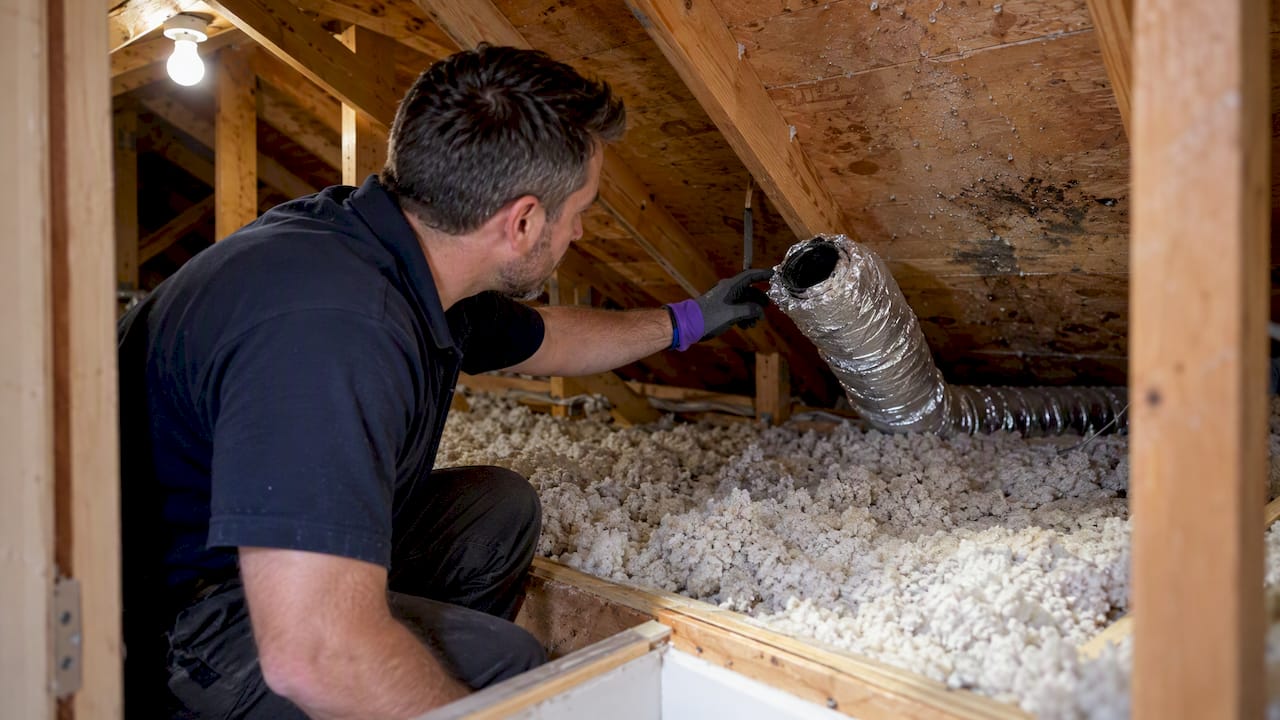
Bathroom fans should never vent into an attic; instead, they must terminate outdoors through a roof cap, gable vent, or wall exhaust. Venting into the attic traps warm, moist air, which condenses on cold surfaces and can lead to mold growth within days, as stated by the EPA. This improper venting also soaks and damages insulation, reducing its effectiveness and violating model building codes, which require exhaust air to discharge to the building exterior.
No, a bathroom fan should never vent into an attic. It must terminate outdoors, through a roof cap, gable vent, or wall exhaust. Venting into the attic traps warm, moist air where it condenses on cold surfaces, inviting mold growth within days and soaking insulation that model codes and building-science guidance both say has no place there.
TL;DR:
- Venting bathroom fans into the attic causes mold growth within days and damages insulation, which reduces its effectiveness and can lead to costly repairs.
- Building codes demand that exhaust fans discharge outdoors; venting into the attic is considered improper and a common cause of moisture-related damage.
- Proper installation requires insulated, sealed ducts supported to prevent sagging and condensate pooling, with termination points at the roof, wall, or gable vent.
- Inspecting whether a fan vents into the attic involves checking duct paths, signs of moisture damage, and using smoke tests to verify airflow outside.
- Fixing improper venting involves rerouting ducts to proper exterior terminations, sealing and insulating all connections, and potentially calling professionals for complex issues.
Table of Contents
- The Real Risks: Mold, Ruined Insulation, and Structural Decay
- What Codes and Technical Guidance Actually Require
- How to Check Whether Your Fan Vents Into the Attic
- Fixing It: Reroute, Terminate Properly, Insulate, and Seal
- When to DIY and When to Call a Professional
- A Practical Sequence for Fixing It Right
- The Cost of Waiting on a Permanent Fix
- How We Help Homeowners Fix This the Right Way
- FAQ
- Sources
The Real Risks: Mold, Ruined Insulation, and Structural Decay
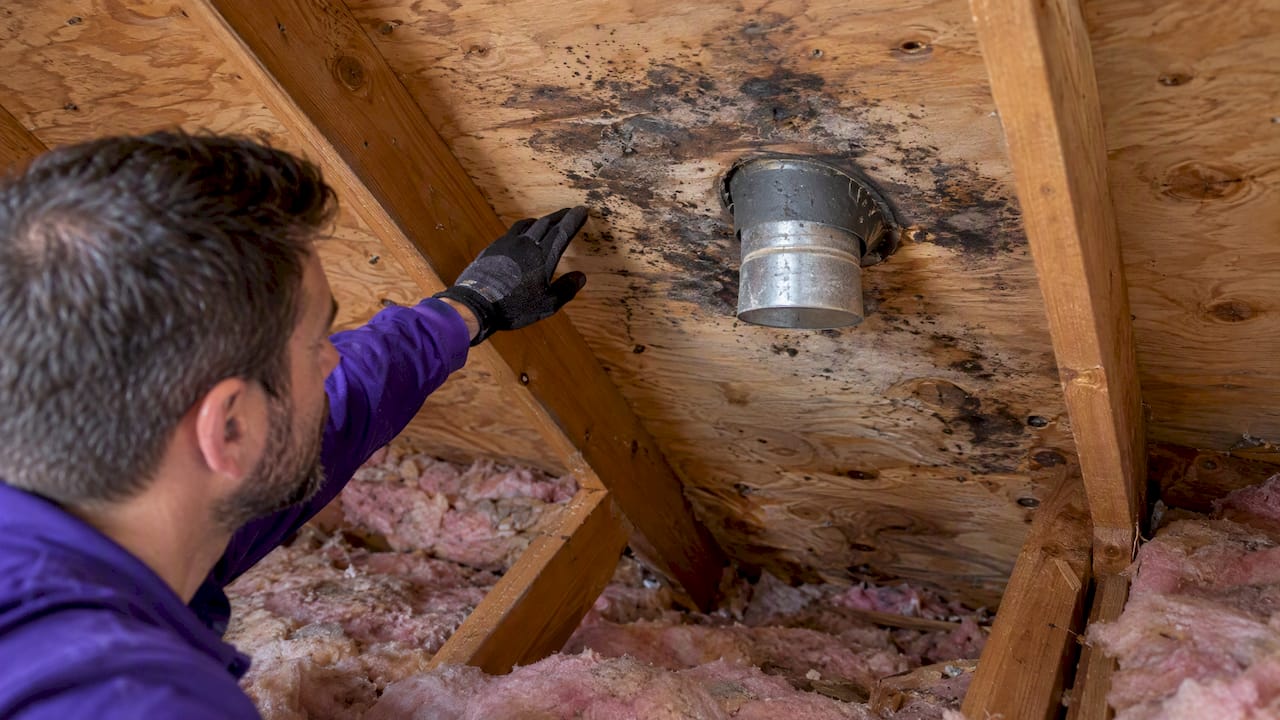
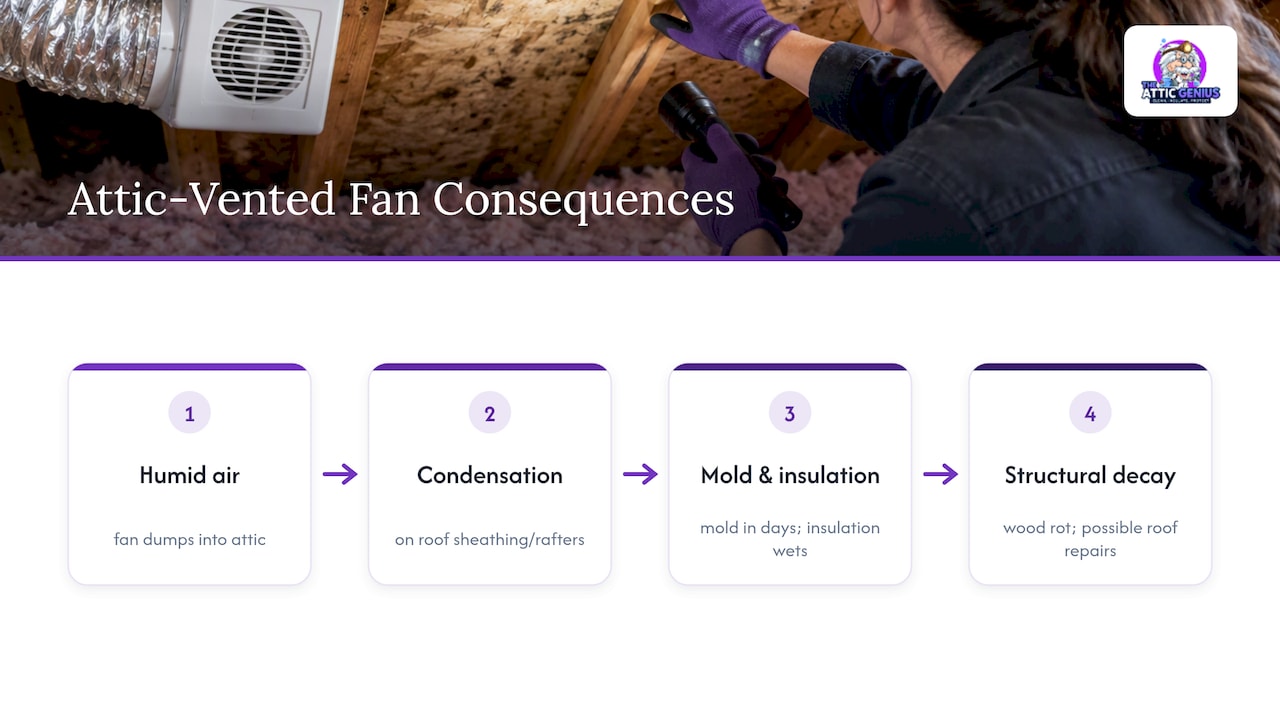
Every time someone showers, a bathroom fan pushes humid air that, if it never leaves the building, condenses the moment it hits cold roof sheathing or rafters. According to the EPA, mold can begin growing on damp surfaces within a couple of days, meaning a fan dumping into the attic can create a mold problem before the end of the week.
Wet insulation stops working. Fiberglass and cellulose both lose a meaningful share of their R-value once moisture infiltrates the fibers, and insulation that stays wet can take weeks to dry, if it dries at all before the next shower adds more moisture.
Left uncorrected, the damage compounds over time, including mold growth on roof sheathing and framing, loss of insulation effectiveness requiring replacement, and potential wood rot that can lead to costly roof repairs.
What Codes and Technical Guidance Actually Require
Model building codes and inspection standards are blunt on this point: exhaust air must discharge to the building exterior, never into an attic, soffit cavity, or crawl space. InspectApedia’s review of bathroom ventilation codes confirms that terminating a bath fan inside the attic is considered improper installation and a frequent cause of moisture damage found during home inspections.
The U.S. Department of Energy and Pacific Northwest National Laboratory lay out the practical installation rules contractors and inspectors follow:
- Insulate ducts that run through unconditioned attic space to at least R-8.
- Seal every joint and connection with UL 181B or UL 181B-M listed tape or mastic, never ordinary duct tape.
- Keep runs short, straight, and mechanically supported to avoid sagging or trapped condensate.
Inspectors also check for an exterior hood with a working damper, proper flashing at the roof or wall penetration, and a duct that slopes slightly downward toward the exterior so condensation drains out instead of back into the fan housing.
How to Check Whether Your Fan Vents Into the Attic
A quick inspection tells you where you stand before you call anyone.
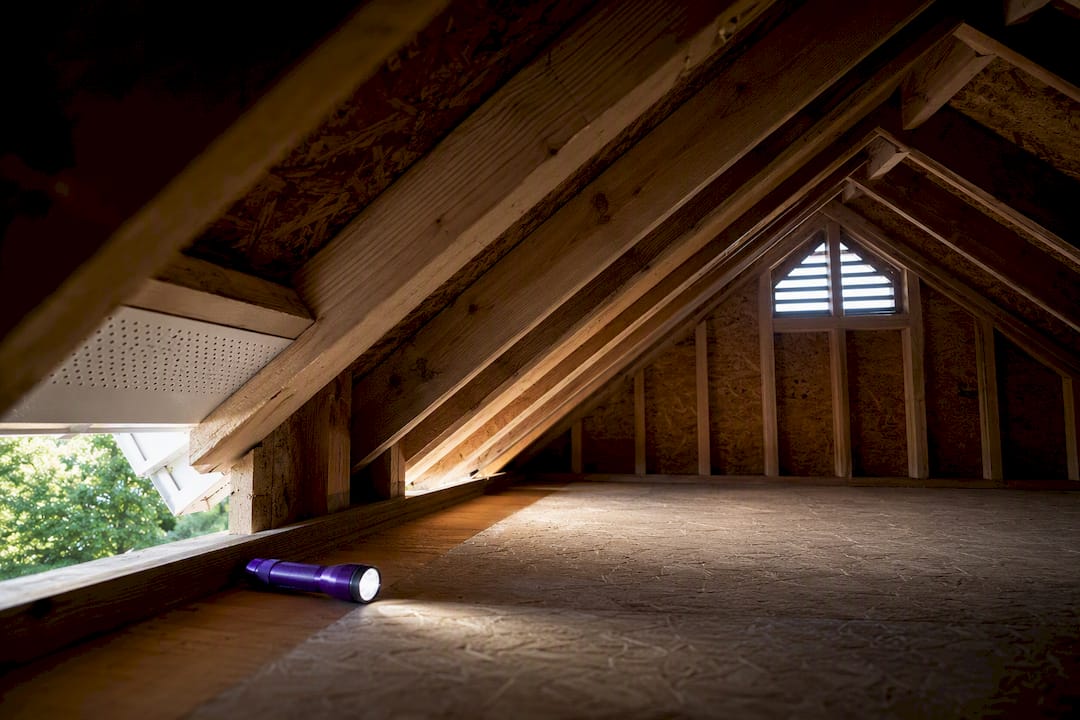
- Turn on the fan and go up into the attic with a flashlight.
- Follow the duct from the fan housing to its end point: if it stops short, hangs open, or dumps air loosely into the attic space, that is your answer.
- Look for damp or discolored insulation, dark staining on sheathing, visible mold, or frost accumulation near the duct’s termination in colder months.
- Back inside, note any chronic signs: mirrors that stay fogged long after a shower, a musty smell near the bathroom ceiling, or ceiling stains.
A simple incense stick or smoke pen held near the fan grille, drawn toward the fan and never seen exiting outside the house, is a fast way to confirm the duct never reaches open air.
Pro Tip: Attics can hide weak flooring, loose insulation over joists, and sharp staples. Step only on joists or a stable board, and if you see knob-and-tube wiring or vermiculite insulation, stop and call a professional instead of continuing the inspection yourself.
Fixing It: Reroute, Terminate Properly, Insulate, and Seal
Once you confirm the fan dead-ends in the attic, the fix depends on your roof layout and how much of the duct run is salvageable.
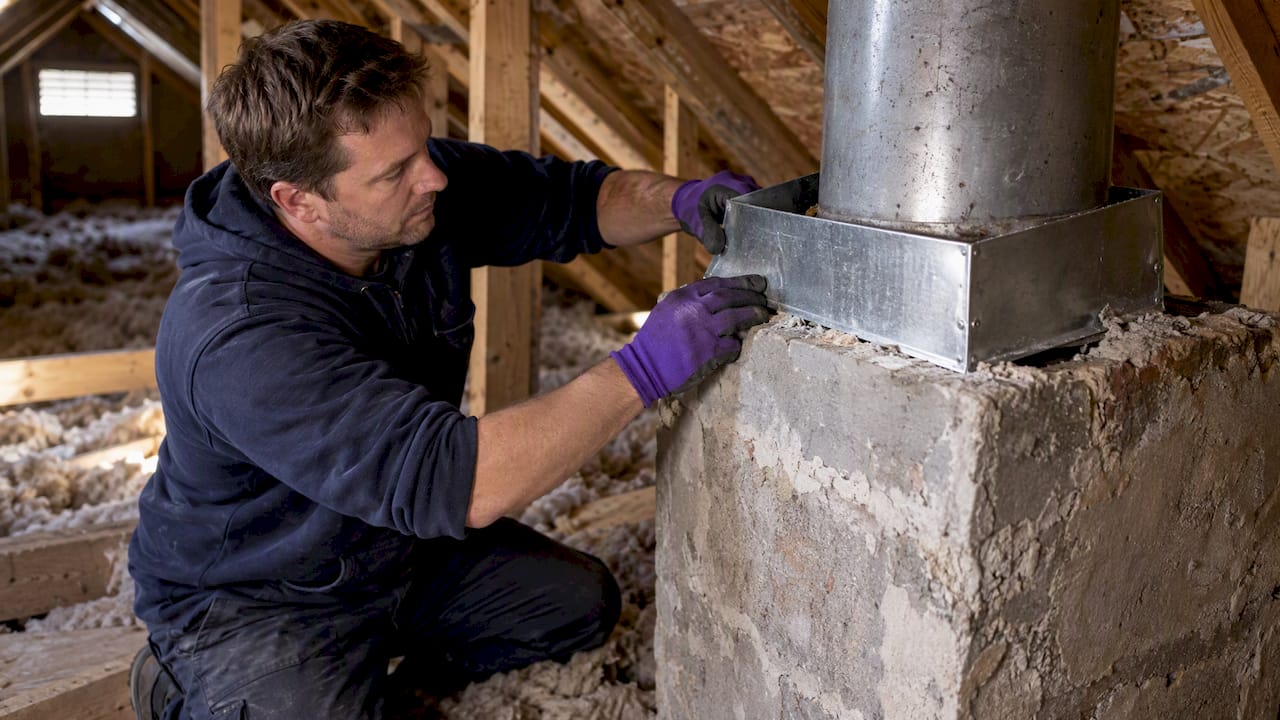
- Roof cap termination: often the shortest path, but requires a proper roof penetration, flashing, and a backdraft damper to stop outside air and pests from entering.
- Gable wall vent: avoids a roof penetration entirely when the bathroom sits near an exterior gable wall, usually the simplest retrofit.
- Through-wall termination: works well for ground-floor bathrooms but needs enough exterior wall clearance from windows and doors per code.
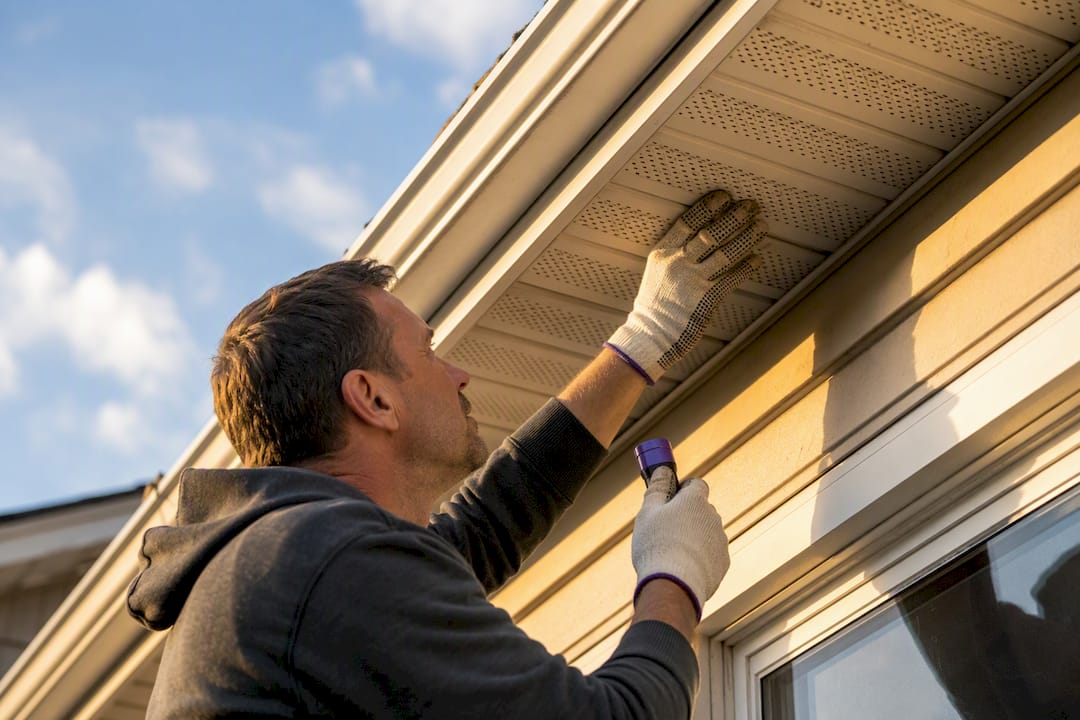
- Soffit termination: tempting because it looks simple, but Energy Vanguard’s field documentation shows many soffit attempts fail when exhaust gets pulled right back into the attic through nearby intake vents. A soffit termination only works with sufficient discharge velocity and real distance from any intake point.
During remediation, GreenBuildingAdvisor notes that dumping exhaust into the attic was tolerated in older, leakier homes but causes real damage in the tighter, better-sealed homes built or retrofitted today.
| Fix approach | Typical difficulty | Key requirement |
|---|---|---|
| Roof cap | Moderate to high | Flashing, backdraft damper |
| Gable vent | Low to moderate | Short straight run to wall |
| Through-wall | Low to moderate | Exterior clearance from openings |
| Soffit | High (often fails) | High velocity, distance from intakes |
Whatever route you choose, use rigid or insulated flexible metal duct rather than thin, sagging flex, insulate any run through the attic to R-8, support it every few feet, and avoid low points where condensate can pool, as explained in tips for improving HVAC efficiency here. Increasing the fan’s CFM is not a fix: more airflow through a duct that still terminates in the attic just moves more moisture into the same trapped space.
When to DIY and When to Call a Professional
Some fixes are well within reach for a handy homeowner. Reconnecting a duct that slipped loose, adding a short insulated extension to reach an existing roof or wall cap, and sealing visible joints with mastic are reasonable weekend projects.
Other situations call for a professional:
- Any new roof penetration or flashing work, where a mistake means leaks.
- Visible mold on sheathing or insulation that needs proper remediation, not just a wipe-down.
- Attics with vermiculite insulation or old knob-and-tube wiring near the duct path.
- Full attic air sealing or insulation restoration after the duct is corrected.
Pro Tip: Before scheduling an inspection, take a few photos of the duct’s current path and note any stains or soft spots you noticed, which speeds up the estimate and helps the contractor plan the right termination point.
A Practical Sequence for Fixing It Right
Whether you tackle this yourself or hand it to a contractor, the order of operations matters:
- Inspect the attic and confirm the duct’s current path and condition.
- Dry out and remediate any wet insulation or early mold before closing anything up.
- Reroute the duct to a proper exterior termination with flashing and a backdraft damper.
- Air-seal the new penetration and any gaps around the duct run.
- Insulate the duct to R-8 and seal every joint with UL 181B-rated materials.
- Restore or replace affected attic insulation and verify the fix.
Verify success by running the fan and checking for airflow at the exterior cap, then returning to the attic after the next few showers to confirm no new condensation or staining appears near the duct.
The Cost of Waiting on a Permanent Fix
Homeowners often patch around the symptom, a stronger fan, a towel over the mirror, instead of fixing where the air actually goes. Every month that duct keeps dumping into the attic, you’re trading a modest repair now for mold remediation or a roof repair later.
— Jim
How We Help Homeowners Fix This the Right Way
We specialize in attic-related problems like this one, so when a bathroom fan is found venting into the attic, we handle the whole picture: free inspection, air sealing around the new duct penetration, insulation restoration, and moisture and mold remediation if damage has already started.

Our team provides pricing information and warranties on the work, and inspections are often available if you want a second set of eyes before deciding on a fix. If you’ve confirmed your fan vents into the attic or just want to rule it out, schedule an inspection with The Attic Genius and get a clear plan instead of guesswork.
FAQ
Is it normal for a bathroom fan to vent into an attic?
It was common in older homes with leaky attics that could tolerate some moisture, but it is not a safe or acceptable practice in modern, tightly sealed homes. Building science sources now treat it as a defect that causes mold and insulation damage rather than a normal installation choice.
Is it code to vent a bathroom fan into the attic?
No, model codes and inspection standards require bathroom exhaust to terminate at the building exterior, not inside an attic or crawl space. An inspector who finds a fan dumping into the attic will typically flag it as an improper installation.
Can I replace a bathroom exhaust fan without going into the attic?
Swapping the fan unit itself, the motor and housing inside the ceiling, can sometimes be done from inside the bathroom, but confirming where the duct actually terminates almost always requires checking the attic. If the existing duct already reaches a proper exterior cap, replacing just the fan unit is straightforward.
Do you need an insulated duct for a bathroom fan in an attic?
Yes, any duct run through unconditioned attic space should be insulated to at least R-8 and sealed with UL 181B-rated materials to prevent condensation from forming inside the duct itself. An uninsulated duct in a cold attic can sweat internally even after you’ve fixed the termination point.
Sources
- A brief guide to mold, moisture, and your home — EPA
- Install exhaust fan flex duct (bath fan only) — U.S. Department of Energy / PNNL
- Bathroom vent fan codes, installation, inspection, repairs — InspectApedia
- Venting bathroom exhaust air — GreenBuildingAdvisor